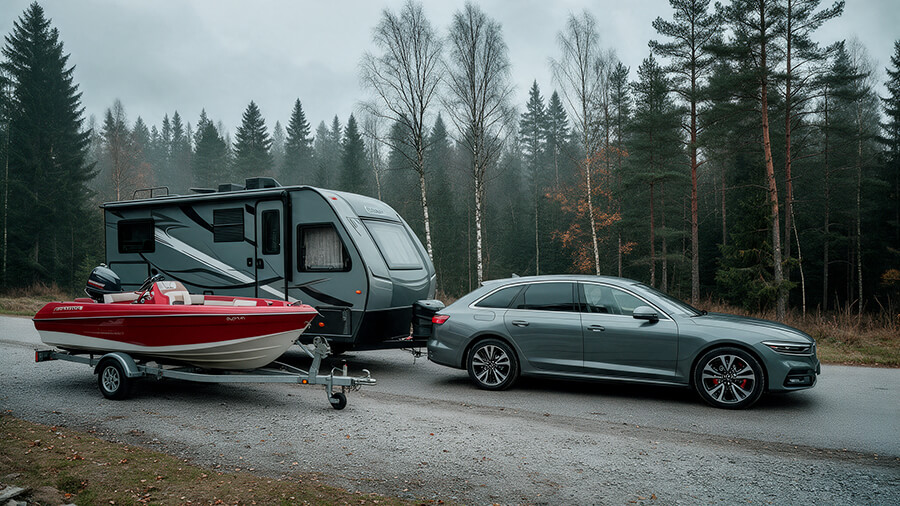
The need for a trailer usually comes out of nowhere. You start a renovation, you buy a boat, you plan a caravan holiday, or you're helping a friend move. The towbar is there, the trailer is rented, and you're ready to go. And this is exactly where many drivers get an unpleasant surprise: it turns out an ordinary category B licence isn't enough for that trailer.
Towing with the wrong category counts as driving without the right to drive in Estonia. That means a substantial fine and, in the worst case, suspension of your driving rights. Let's go through where the line runs between B, B96 and BE, how to work out which one you need, and what the training involves.
Category BE lets you drive a category B vehicle (maximum authorised mass up to 3500 kg) together with a trailer whose maximum authorised mass goes up to 3500 kg. In practice the combination can theoretically reach 7000 kg in total, provided the technical specifications of your car allow it.
In plain terms, BE covers almost every everyday need: a heavy box trailer, a boat or jet ski trailer, a car transporter, or a caravan.
This is where most of the confusion sits. Category B allows towing in two situations.
First, a light trailer with a maximum authorised mass of up to 750 kg. These fall into category O1 and brakes aren't mandatory on them.
Second, a trailer heavier than 750 kg, but only if the combined maximum authorised mass of car and trailer doesn't exceed 3500 kg. In practice that means a light car with a light trailer, because even a mid-size SUV plus a trailer will already break that limit.
If the combined maximum authorised mass goes over 3500 kg but stays under 4250 kg, you don't need full BE. It's enough to add code 96 to your licence.
The big advantage of B96 is that no driving school training is required at all. You only need to pass a driving exam at the Transport Administration, using your own car and a trailer that isn't a light one (in other words, heavier than 750 kg). Both vehicles must be technically sound, and you need to bring the registration certificates for both.
Do the maths from the documents, not by eye. Take the registration certificates for your car and trailer and add up their maximum authorised masses.
If the total doesn't exceed 3500 kg, plain category B is enough. If it falls between 3500 and 4250 kg, you need code B96. If it goes above 4250 kg, you need category BE. One separate case: a trailer up to 750 kg is always allowed on category B, regardless of how heavy the car is.
A useful thought for the future: even if you fall into the B96 range, many people go straight for BE. The training is short, and you avoid the situation where a year later you need a heavier trailer and have to start over.
Even with BE in your pocket, you can't hitch just any trailer to your car. The technical capability of the vehicle matters just as much, and this is where most mistakes happen.
Your car's registration certificate has two fields: O.1 (maximum permitted mass of a braked trailer) and O.2 (the same for an unbraked trailer). That's the limit set by the manufacturer.
Here's the nuance that trips people up: requirements for the driver are assessed by maximum authorised mass, while the car's technical limits and roadside police checks go by actual mass. This means you may tow a trailer whose documented maximum authorised mass exceeds your car's O.1 figure, but you must not actually load it heavier than the manufacturer permits. At the same time, your licence category has to cover the trailer's documented maximum authorised mass.
One more detail that's easy to forget: in winter, the trailer needs winter tyres matching those on the towing vehicle. If your car has studded tyres, the trailer needs studs too.
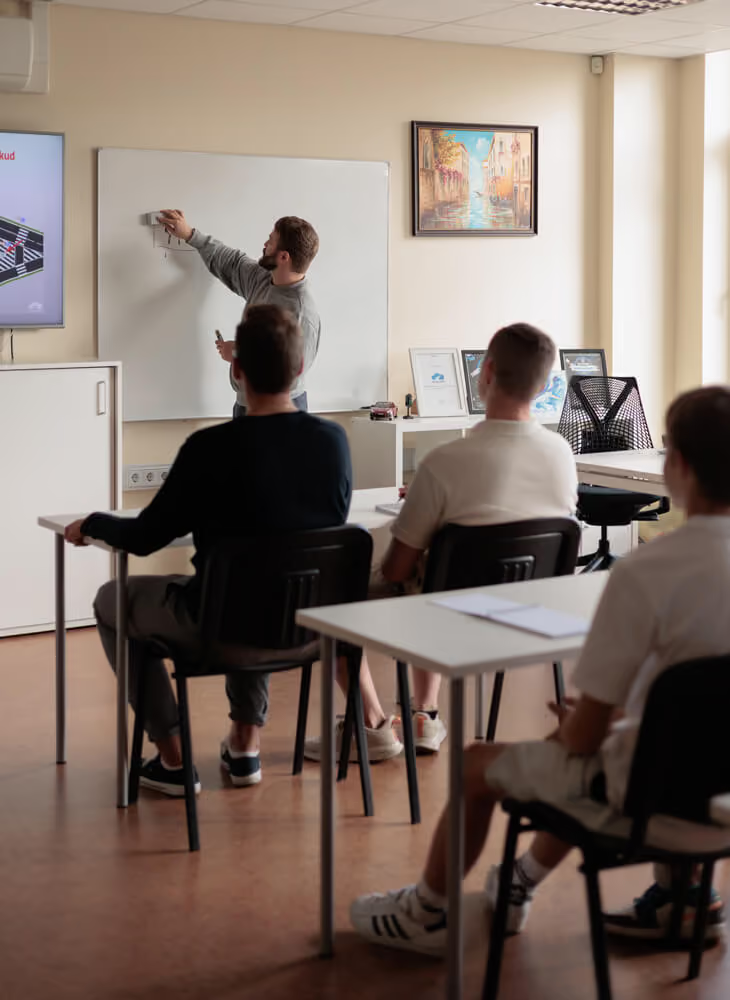
BE training counts as supplementary training, so it's much shorter than a full beginner course. The mandatory prerequisite is holding a category B licence.
The required minimum is 3 hours of theory and 2 driving lessons. The theory focuses on what actually matters when towing: masses and how to calculate them, securing the load, tow hitch weight, how a combination behaves on the road, braking and road safety.
The practical side covers manoeuvring exercises on the training ground (hitching and unhitching, reversing, manoeuvring) as well as driving in real traffic. After the course, the driving school runs an internal check, and then you take the state exam at the Transport Administration.
Good news: most students find the BE exam straightforward, since they already have driving experience and the exercises are fairly simple. The main adjustment is getting used to the length of the combination and to the fact that a trailer reverses in the opposite direction to what your instincts expect.
Worth knowing separately: if you currently hold a provisional licence (esmane juhiluba), you can attend the BE course, but you can only sit the exams after exchanging it for a full licence. So if that exchange is coming up anyway, it makes sense to time the course to line up with it.
A question we get regularly. Your health certificate needs to be valid, but you don't need a new medical check: categories B and BE both belong to Group I drivers, so the certificate issued for B also covers BE.
The first aid course is also a one-time requirement. If you already obtained your category B in Estonia, you have the certificate and don't need to repeat the training.
What trailer can I tow with a category B licence? A light trailer with a maximum authorised mass up to 750 kg, or a heavier trailer as long as the combined maximum authorised mass of car and trailer stays under 3500 kg.
What's the difference between B96 and BE? B96 is an additional code for combinations between 3500 and 4250 kg, and it requires no training at all, just a driving exam at the Transport Administration. BE is a full category for trailers up to 3500 kg and requires a course at a driving school.
How long is the BE course? The minimum is 3 hours of theory and 2 driving lessons, followed by an internal check at the driving school and the state exam at the Transport Administration.
Do I need category B to join the BE course? Yes, a category B licence is mandatory. With a provisional licence you can attend the course, but you can only take the exams after exchanging it for a full licence.
Do I need to redo the health certificate and first aid course? No. The health certificate issued for category B also covers BE, since both fall under Group I drivers. The first aid course is completed once.
Does a foreign licence count for the BE course? If your licence is valid in Estonia and includes category B, you can take BE training here. If you're unsure whether your licence qualifies or needs to be exchanged first, check with us or with the Transport Administration before enrolling.
What happens if I tow without the right category? It counts as driving without the right to drive: a substantial fine and possible suspension of your driving rights. There's also a real safety risk, since a heavy trailer changes how the car behaves on the road.
.avif)
.avif)