
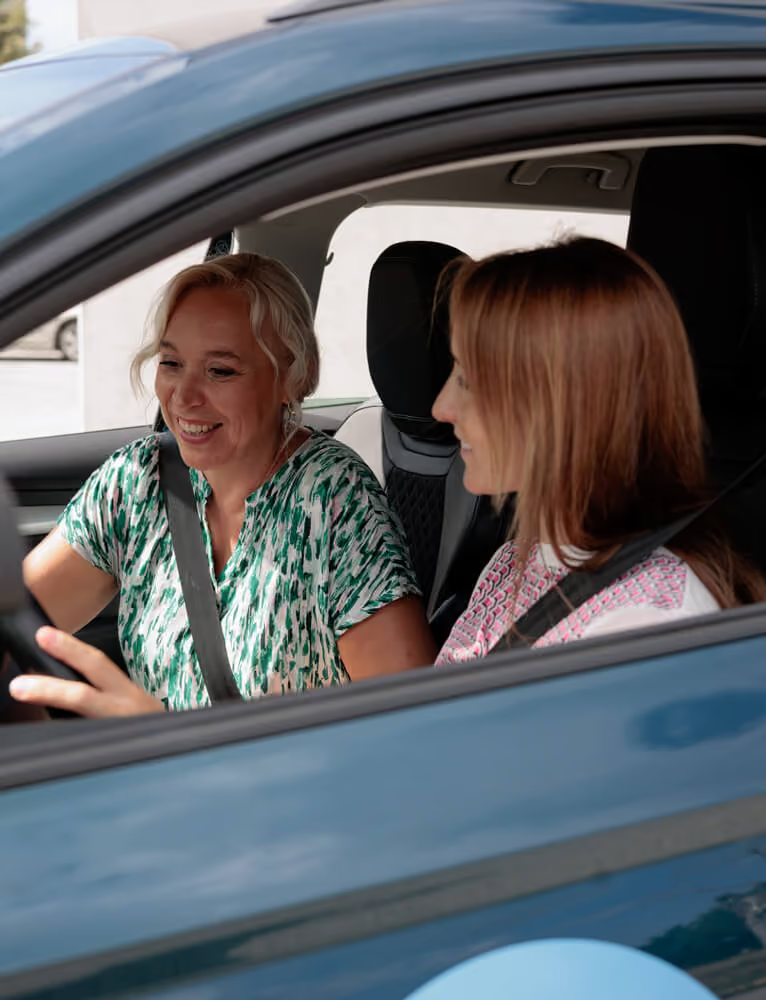
A driving instructor at a driving school is more than just an instructor — his quality largely depends on how well the student prepares for the exam and what driving habits are developed. A good teacher creates a supportive learning environment and guides the student to acquire the knowledge, skills and correct attitudes that are a prerequisite for developing a responsible leader. Research showsthat when choosing a driving school, it is critical to find the right driving instructor and to give preference to a school with a higher student completion rate — these indicators characterize the quality of training.
An experienced and competent teacher helps the student successfully pass the national exam, but more importantly, shapes safe driving habits and traffic behavior. Novice drivers are one of the most vulnerable groups in traffic, so it is crucial that the first instructor teaches the right techniques and safety awareness from the start. It should be remembered that the driving test is only one intermediate stage in the driver's journey - passing it gives the right to independently practice and learn. Thus, a good teacher lays the foundation for a further safe driving experience even after receiving a driver's license.
.avif)
Teacher Qualification: In Estonia, every teacher of a motor vehicle driver must undergo appropriate training and hold a teacher's license (certificate) issued by the Transport Authority. This proves that he has the required training, and the teacher's license is valid (usually valid for 5 years, after which you need to undergo advanced training and apply for a new certificate). In most cases, it can be trusted that only licensed teachers work in a driving school with an official training license. However, if interested, one can ask the teacher about his background: for example, when he underwent teacher training or whether he has advanced professionally. Some schools have presentations of teachers with experience and education on their websites — from there you can check the existence of a teacher's professional certificate as well as additional skills (e.g. skidding or eco-driving training).
Teacher Experience: Find out how long the teacher has been and whether he or she has experience teaching your desired category. For example, if you plan to study category A (motorcycle), it is good to know that the teacher is competent to instruct motorcyclists. Experienced teachers are familiar with exam requirements and are able to prepare students effectively — positive comments about the teacher's long-term experience are generally a good sign. However, a large number of years does not automatically mean the best teaching skills; constant self-improvement and keeping up with the times are also important.
Teaching style: Every learner is different, so it's worth finding a teacher whose teaching style matches your learning style and character. In reviews and recommendations, it is worth looking for clues as to whether a particular teacher is more of a calm and patient nature, or tough and demanding. Ideally, the teacher is demanding just within the right limits — enough to discipline and make all the necessary requirements clear, but not overly harsh or nervous, which could scare the student instead. The teacher must be able to explain complex traffic rules and driving directions in an understandable way, demonstrating patience and empathy. The study found that students highly appreciate teachers who can calmly and clearly decipher traffic situations — but unfortunately, sometimes they complain that some teachers are overly critical and only highlight the negative aspects. So watch for signs of the teacher's communication skills: will he be able to give constructive feedback in case of mistakes, or will he immediately begin to whine. A good communicator encourages you to ask questions and learns to admit your own mistakes when, for example, a topic needs a more thorough explanation.
Language skills: Make sure that the teacher speaks the appropriate language with you. In Estonia, many teachers work in Estonian and Russian; several also speak English. If your mother tongue is not Estonian or you feel more comfortable in another language, be sure to find out beforehand whether the teacher knows the language well enough to teach it. Communication problems due to the language barrier can significantly complicate the learning process, so it is important for the teacher and the student to find a common language, both in the direct and in the transferred sense.
Before making a final decision, it is worth contacting the teacher or driving school and asking a few important questions. A good driving school or teacher takes the time to answer your questions - this already shows the attitude towards the student. Here are some examples of questions and topics to research about:
In general, direct communication with the teacher gives a lot of information. Already from the telephone conversation or the first meeting you can get an idea of whether the teacher is a welcoming, friendly and professional communicator. If possible, talk to the teacher before signing the contract - ask questions, explain your goals and see if trust builds. This is your chance to “interview” the teacher, because your entire learning experience can depend on him.
.avif)
Today, fortunately, students can find a lot of feedback on driving schools and teachers on the Internet. Google reviews, Facebook recommendations, forum discussions (such as Auto24 or Price Watch) and even Reddit are places to find the experiences of former students. Reading the opinions of others helps to avoid mistakes in the choice - but it is important to be able to analyze these reviews critically.
Multiple sources: Don't limit yourself to one channel — you get the best insight when you gather information from multiple sources. For example, read Google reviews to get an overall impression, visit the Valiautokool.ee platform, which gathers prices, locations, attendance statistics and student ratings of driving schools, and also find out about social media. There are groups on Facebook (e.g. by city) and recommendations for driving schools and teachers have been repeatedly asked in the Estonian sub-forum of Reddit — the feedback from there is often very sincere and honest. On the websites of driving schools themselves, there is often a separate section “Student Feedback”, where you can read success stories; however, it is worth remembering that most often only positive stories are displayed on the school's website.
What to focus on when reading reviews?While browsing through the reviews, try to sift out the aspects that are important to you when choosing a teacher:
In summary: reviews are an excellent source of information, but analyze them consciously. Look for repeating patterns: If many praise the same teacher or the same school advantage, then there is probably a basis for this. Also, if several warn about some specific problem (for example, “the teacher was often late” or “the school charged extra for every little thing”), then take these warnings into account. It's still not worth setting aside a very good school for one or two angry voices, but if there are a lot of negative comments and they are similar, this is a sure signal.
Not all teachers and students may be compatible with each other — that's human. However, there are certain red flags in a teacher's behavior or way of working that indicate that he may not be doing his job well or is not a good fit for you. Here are some danger signs, if they appear, it is worth seriously considering changing the teacher or even changing the driving school:
In conclusion, your sense of selfdriving time is a very important indicator. You will learn to drive a car, but at the same time your confidence as a driver will also develop. If after classes you always feel bad, or rather, self-confidence is waning, then the problem may be in the teacher. With a good teacher, you should feel that with each lesson you become a better and more courageous leader. Don't be afraid to act when negative signs show up — ultimately it's your time, money and safety that are at stake.
.avif)
Not everyone has the same learning preference or starting position. Some students need more attention or special methods than usual - be it neurodifferences (e.g. ADHD, Asperger's, autism spectrum characteristics), severe anxiety, special sensitivity, or even language that is not the same as the teacher. In such cases, it is especially important to find a teacher who understands and takes into account your needs.
Anxious and insecure learners:If you know in advance that you are afraid of driving or are generally an anxious student, look for a teacher who has been described by students as calm and encouraging. Some driving schools and teachers also emphasize “stress-free learning” or “calm driving experience” in their advertising. In student feedback, this can be reflected in the words that the teacher helped overcome the fear of driving and created a safe feeling in the lesson. This is the kind of instructor you need. For example, there are teachers in Tallinn who are praised for their do not quarrel over mistakes, but calmly discusswhat happened and how to do better next time. With such a teacher, you will learn to overcome your fear step by step. So, if you have anxiety, ask the driving school directly if they have experience coaching anxious or very insecure students — their reaction will give you an idea of whether you will be accepted with compassion.
Students with neurodifferences:If you have been diagnosed with an attention deficit disorder, learning disability, or other neurological feature, consider informing the school early on. This does not necessarily mean that you will be treated differently, but a good school can choose a tutor for you who is patient and flexible in approach. Some teachers may have previous experience teaching a student on the autism spectrum, for example, or are simply very structured instructors by nature (which will benefit those who need more order and routine). You might ask, “Have you had students with ADHD, for example? How have you adapted your studies?” — this will help you understand if the school is ready to adjust the curriculum a bit if necessary (e.g. take more short driving lessons instead of longer ones, give breaks, etc.). Ultimately, the goal is for the learner to feel comfortable and be able to learn at their own pace even when they have a special need.
Language Barriers and Cultural Differences:If Estonian is not your native language, language skills are a critical factor in choosing a teacher. As mentioned earlier, find out the language skills of the teacher — there are Estonian, Russian and English teachers in Estonia. If you find a teacher who can teach in even two languages in parallel (e.g. explains the theory in Estonian, but gives driving instructions in Russian), then this can greatly simplify your learning. Some driving schools list the languages of teaching with teachers on their website (e.g. “Language of instruction: Estonian, Russian”). Culturally, there may also be nuances - for example, if you come from abroad and the traffic culture is new here, then a patient teacher who can compare and explain the differences will be of great help. Feel free to tell the teacher or school about your background; the more they know about you, the better they can tailor the learning.
Special physical needs:If you have any physical disability or special needs (for example, disability of movement, limited hearing, etc.), the choice must be made even more carefully. Some driving schools specialize, for example, in training people with reduced mobility (with adapted cars). In this case, find out directly from the Department of Transport or professional associations which schools offer the corresponding service. If you only need a little adjustment - for example, poor hearing, but otherwise you can do it in a regular car - let the teacher know. Maybe you can sit on a safe side, use a hearing aid, or something else that makes it easier to communicate in class. A good teacher is willing to make small changes to make the learner feel safe.
Summary of Special Needs:Be frank with yourself and inform the driving school about your specifics. Do not be afraid that this will make you a more “troublesome” student - a professional school values this information and will try to find a solution that suits you. Your goal is to find a teacher who understands your strengths and weaknesses and who continues to have empathy and ingenuity to adapt the teaching methodology accordingly. With a properly selected teacher, a special need does not become an obstacle to obtaining driver's licenses.
Many students do not know that it is possible to change driving instructors in a driving school - if necessary, even in the middle of the course. In fact, it is your right as a customer to receive the service in such a way that you are satisfied and prosper. If you feel that the current teacher is for you not at alldoes not fit (for example, a conflict constantly arises or you simply do not progress under his hands), then do not endure to the end in the hope that “suddenly it will get better.” Here are the steps on how to make a teacher change politely and officially:
In conclusion: do not be afraid to change teachers. Studies show that nearly half of students have changed teachers during their studies — you would be no exception. Many did not even know at first that this possibility existed. After all, it is important that you learn to manage well and feel confident. If you need another tutor, so be it.
Often, future students ask: should you rather choose a well-known and reputable driving school, hoping that there will also be good teachers there, or choose a specific well-known good teacher, even if his school is perhaps not the most namesake? Ideally, of course, you get both - a strong school and a great teacher in one package. But if you need to choose an emphasis, then it is worth considering the following circumstances:
Good driving school: The plus of larger or more well-known driving schools is often a tried-and-tested curriculum, quality control and support system. They typically have multiple teachers, spare cars, a clear lesson plan, and less getting bogged down in red tape. Pass rates for reputable schools are often above average. For example, if the entire school has a high pass rate of exams%, this gives an idea that in the school as a whole, learning is carried out with high quality. Also, if the school is pan-Estonian(such as Autosõit OÜ or Autosert, etc.), they have uniform standards — less risk of falling completely into the hands of chance. If you don't have a specific teacher in sight, it's a wise act to pick out a few reputable schools and see which teachers work for them.
Very good teacher: On the other hand, the person of the teacher determines your daily learning experience. Even in the best driving school you can find a teacher with whom you have no qualms, and vice versa - in a school with a mediocre reputation, you can work a real piece of gold. If you have learned from a reliable source (a friend's recommendation, several independent reviews) the name of a teacher who is highly praised, consider studying with him. In the end, it is you who repeatedly spend hours in the car with the teacher, and his teaching style directly affects you. Some students have made a choice by choosing a school according to a particular teacher — they registered there because they wanted to study under him. There is nothing wrong with that. Just find out in advance if this teacher is definitely available (some popular teachers may have a tight schedule). Also, consider that if you choose a small driving school for just one super-teacher, some of the more general disadvantages of the school may still have an impact (e.g. the general organization of the school may be chaotic or the teaching cars may not be in the best condition).
Finding Balance:It can be said that the choice of a driving school and the choice of a teacher go hand in hand. In practice, do this: set out what is most important to you. If you have a language or special needs requirement (for example, you need to learn Russian or a particularly patient tutor), the importance of the teacher will increase — even choose a school from an empty place based on the fact that there is a suitable person for you. If you have no special wishes and just want to be sure of a good education, then first look at the reputation and statistics of the schools, and then ask in these schools who are their most experienced and valued teachers. For example, you might discover that “School X is more expensive, but everyone praises their teacher Y to heaven”. Then the choice is simple. Or vice versa: “Teacher Z is known for a good calm hand, although he works in a rather little-known school” - then you have to decide whether you trust yourself in his care, regardless of the name of the school.
In some ways, the teacher is more important than the school, because in one-on-one learning, a good teacher can also “save” a poor school organization. But the ideal situation is worth striving for - why not choose good schoolyes good teacher. For example, look at the statistics of the Department of Transport (or the comparison table of the Traffic Lab) and select schools with pass rates that are above average. Then read the reviews about them and see if any of the teachers stand out with particularly commendable ratings. This is how you will find the combination with which it is more likely to achieve both a pleasant learning process and a successful exam result.
By the way, do not forget that the role of the learner himself is also crucial. In the best case, the teacher and the school will not help if the student does not bother to make the effort himself. As aptly stated in a discussion in one of the forums:”A good driving school is just as good as the student himself“You also have to make the rules clear and practice. Therefore, whatever you choose, approach your studies seriously - then it will be easier for both the teacher and the school to offer you the best.
Student recommendations are the golden stuff—when someone who has just received their permits says that”be smart to others too and go to that teacher“, then it's worth hearing. It always makes sense to study their experiences from acquaintances and friends. Especially, if you know someone with a similar character or situation to you, feel free to ask how he got along with his teacher. For example, if your friend is a fearful leader like you, and his teacher was able to teach him to be brave, that teacher is probably the right fit for you too.
Finally, there are good teachers all over Estonia, both in Tallinn, Tartu, Pärnu and in smaller places. Often it is the teacher who is remembered for life by the student as the first guide in the world of traffic. A good teacher conveys, in addition to driving skills, respect for traffic and the confidence that every student will be able to become a good driver. So it's worth taking the choice of a teacher seriously — read, listen, find out the background — but once you've found the right person, trust them and do your best. This is how these success stories are born, in which the student praises:”Thank you to my teacher — without him I would never have dared to get behind the wheel!”.
Transport Authority: Official information about the theory exam.
Traffic Lab: Teaching materials, exam tests and mock exams.
Estoni.ee: State portal (general information can be found in the driver's license section).
Theory.ee: Another platform for theory learning and test solving.


.avif)