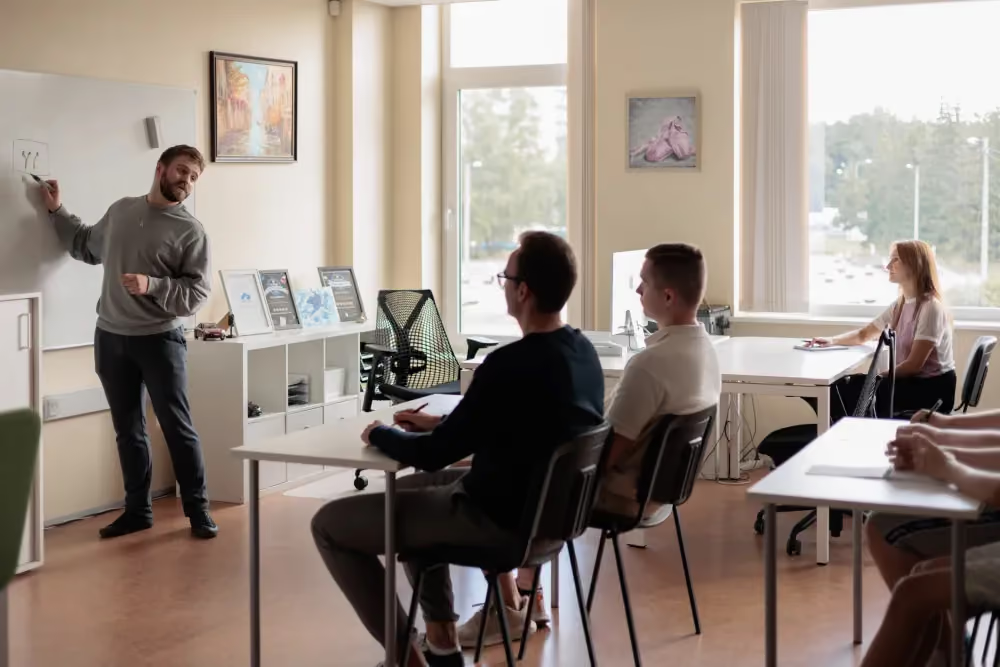
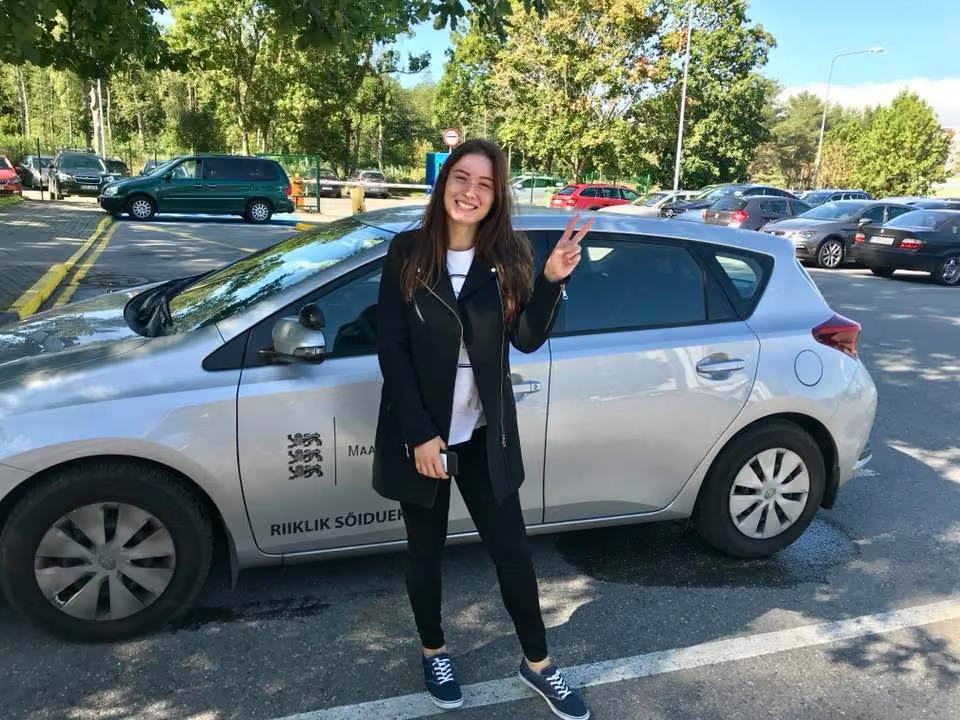
Practical exam(for driving a category B vehicle) is the final step in obtaining a driver's license, which will test your real driving skills in city traffic and on the road. This exam is demanding — in Tallinn, for example, more than 60% of first-time testers fail the national driving test. The main reasons for failure are often insufficient preparation or going to the exam to “try your luck”, which is a time and money consuming approach. The only sure way to successfully pass the exam is to thoroughly prepare.
The national driving test shall be conducted by an examiner of the Transport Authority and shall last at least 45 minutesActive driving. Before you start driving, your identity and documents will be checked - you should show up 15—20 minutes earlierand bring a valid identity document (without it you will not be admitted to the exam). Before entering the road traffic, the examiner will introduce the exam rules and ask two inspection questions about the construction/safety of the vehicle (e.g., being asked to show how to turn on the janitors or hazard lights). Then the ride begins.
TallinnThe driving test for category B will start from 2025 in three possible places: next to the existing Mustamäe Heli tn 6, also near the offices of Lasnamäe Valge tn 4 and Teelise tn 4. The purpose of adding new starting points is to provide more versatile routes and also to include out-of-town sections of road. This means that the exam routes in Tallinn can run in different districts and directions — the exam preparer must be prepared for both busy city traffic and faster road travel. Driving during the driving test both on the inner road and on the out-of-town sectionsand assess the driver's performance in conditions of different traffic densities. The category B exam consists of of two parts:
Immediately at the initial stage of driving, it is necessary to perform parking and maneuvering exercises on streets with little traffic. From 2020, two exercises are mandatory by regulations: reversing in a limited area(so-called three-turn reversing on a narrow road) and parking with maneuver(placing the vehicle in the parking space upside down or forward, as instructed by the examiner). The third exercise is chosen at the discretion of the examiner - this is usually rail parking(ie parallel parking at the edge of the road) or reversing in a straight line or with an arc. There is a total time to perform the exercises up to 10 minutes. In the category B exam, a separate second attempt for the same exercise is not given - the student must decide for himself when the exercise is completed. You have the right to inspect the car from the outside and check the position before approval and, if necessary, make corrections within this time. Be sure to use this opportunity to detect errors before you declare your termination. Most non-sorters happen precisely because of the failure of parking exercises - often due to haste or inattention, not so much a lack of skill. For example, on mandatory “parking with maneuver”Failure in the exercise is a very common cause of exam failure. Also pay attention to safety: after the stop The parking brake must always be applied. Forgetting can mean that the car is not actually parked safely, which is a mistake.
Once the exercises are done, the rest of the exam will take place on streets with different traffic densities. In Tallinn, this means that you can drive in the traffic jams of the city center, complex multi-lane roads, roundabouts, sections with tram and bus lanes, narrow streets in residential areas, as well as on motorways or highways outside the city limits. The Transportation Authority wants the driver candidate to demonstrate their ability to deliver independently and safely in a wide variety of situations. Therefore, the examinee must be prepared adjust speed according to road and weather conditionsand use the maximum permissible speed, if circumstances permit (for example, 90 km/h when driving on an out-of-town road). It is important to comply with all traffic rules and take into account other road users — the examiner's task is to assess whether you are ready to act as a driver independently and safely. The exam ends when you return to the service office, and the examiner makes a summary. The result is given in the form of grades: 'considered'(passed), 'with notes considered'(passed, but errors were pointed out) or “unaccounted for”(failed). The presence of minor errors, as a rule, does not prevent you from passing the exam - the main thing is that there are no dangerous violations. For example, if you make a few small mistakes (for example, you briefly forget the direction at the right moment or drive 3 km/h above the allowed one for a moment), this does not automatically mean failure. The examiner evaluates the ride as a whole, so stay calm and keep driving — when you start panicking about a mistake you made, nervousness often breeds new mistakes like mushrooms after rain.
The most important thing is to choose good driving school and competent driving instructor, under whose guidance you will acquire strong basic knowledge. Find out the background of different driving schools, read student reviews and compare the study programs offered before enrolling. Choosing a good school increases your chances of success — quality teaching materials and a methodical approach will give you a more solid bottom.
Many failures happen because you just go to try your luck, hoping to get through with a little practice. Save yourself time and money and aim to pass the exam on the first attemptInvest enough time in practice. Carefully go through the entire driving school curriculum: attend all driving lessons consistently (avoid long breaks in the learning process) and ask the instructor for feedback on your weaknesses. If necessary, take extra hours over the mandatory minimum until you feel confident behind the wheel. If driving lessons seem expensive, keep in mind that the alternative - repeated failures - is even more expensive (after every third failed exam, at least 2 additional driving lessons must be completed in a driving school, i.e. continuing education). It makes more sense to practice a little more before the state exam than to spend time and money on correcting mistakes later.
Today, there are a number of aids available to help prepare for the practical exam. For example, Traffic Lab offers Virtual Driving Examswhere you can go through an interactive video Real Tallinn Exam Routesand practice tasks under the guidance of a virtual examiner. This simulation will introduce you to all the main “examination places”— difficult situations and road sections, against which examiners are often mistaken. In the virtual environment, you can safely learn about the traffic patterns of Tallinn (traffic lights, traffic signs, timetables) and thus, when you go to the exam, these places are already familiar. In addition, there are plenty of educational videos, parking aids, mobile apps and tests to help you consolidate both theory and practice. If possible, also use the offers of the driving school for mock exams - some schools can control drivewith another teacher to simulate a real exam. The more you play through different situations, the more confident you will feel in the real exam.
In addition to good driving skills, knowledge of traffic rules cannot be underestimated - theory and practice go hand in hand. Errors in the driving test often occur precisely because the candidate driver neglects some rules or misunderstands the sign/situation. Therefore, before the exam, repeat everything traffic signs(in particular, parking/stopping restrictions, beginning and end of speed limits, priority signs, etc.) and important rules(right-hand rule, public vehicle privilege, line-change requirements, interchange passes, etc.). When you go to the traffic test, the rules should be so well in your head that you do not have to think about them for a long time - all attention can go to monitoring the traffic situation. If you have weak points (for example, do not distinguish between signs “Stop is forbidden”yes “Parking prohibited”— one forbids even a short-term stop, the other allows you to stop for up to 2 minutes), be sure to learn them for the exam. If necessary, take additional tests online or play situational games (some educational driving simulators are also available for computer/phone) to consolidate the rules.
As mentioned above, parking exercises are a stumbling block for many. Ask your driving instructor if he train parking and reversing with you both in a narrow place and in ordinary parking lots. The goal is to be able to accurately and smoothly park the car and get back out if necessary. Practice different parking techniques: side box (rail parking) on both the right and left sides, reversing the parking space at an angle of 90°, parking forward in a marked place, etc. Learn to know the orientation points (using a mirror to the rear of the side car, etc.) - they help when parking in real situations. Time Exercise:also try to do the exercises with a stopwatch. Namely, the exam takes 10 minutes after three exercises; on average, one parking session takes ~1-2 minutes for a skilled performer. If it takes a lot longer, try to speed up. without haste— that is, improve the fluency of your actions. Also, be sure to practice getting out of the car after parking and evaluating your work - this is how you get used to doing this on the exam, instead of immediately confirming the completion. Also, remember that before exiting the car, the car must be safely stopped (gear free, parking brake on, engine closed if necessary) and look in the mirror and behind your shoulder so that it is safe to open the door.
The nerve that accompanies the exam is normal, but it can be alleviated with proper preparation. The more certain you know what to do in different situations, the less room there will be for panic. Before the exam day get a good restGo to bed early the night before. In the morning, eat a light meal to keep blood sugar in balance (do not go to the exam on an empty stomach or overeat). Already in driving school, you could learn some calming techniques (such as deep breathing) to apply if you feel very anxious during an exam. If possible, arrange an early morning driving lesson for the exam daywith your teacher - a small warm-up run just before the exam will help to “warm your hand” and relieve the first anxiety tremors. During the driving lesson, if possible, drive around the same service office where your exam begins, so that this area is immediately remembered.
When passing the exam, it is worth knowing what mistakes are frequent stumbling blocks in order to be able to consciously prevent them. In the following, we highlight common mistakes in the category B driving test and tips on how to avoid them:
Some examiners have already failed before they started driving because elementary preparation was forgotten— the seat belt is not fastened, the seat and mirrors are incorrectly set or the operation of the lights has not been checked (e.g. low beam in foggy weather). Hint:Always take a few seconds to get ready for the ride. Adjust the seat to the appropriate distance/length, adjust the mirrors so that they can see well enough to the back and sides, and fasten the seat belt. Turn on the dipped headlights if necessary (on many test cars the daytime running lights are on automatically, but in bad conditions put the lights on manually). This routine shows the examiner that you are attentive and aware.
You quickly forget to look Mirrors and dark cornersbefore maneuvers. For example, a row change without looking over the shoulder or checking the right turns to see if someone (biker/pede) is coming from the right. Such errors can become fatal on the exam. Solution: Demonstratively show verification with your gaze.Turn your head and look visibly both in the mirrors and behind your shoulder before changing direction. It is not necessary to exaggerate, but make sure that the examiner noticesYour views — if you look only out of the corner of your eye, he may not realize that you were actually checking. Practice this habit every hour of driving so that it comes naturally.
A serious exam is, of course failure to grant priorityFor example, if you does not stop at the “STOP” signin front of you completely or does not give wayat the end of the main road to the car coming from the right, the exam is most likely over. There are also frequent problems with signs of speed limits - either you do not notice the start/end of the restriction or you forget what zone you are in at the moment and the speed does not meet the requirements. Confusion is also common no-parking areavs no-stay zonerequirements (e.g. parking in a place where you can only stop for a short time, etc.) Solution:The only grass is thorough knowledge of the rules. For the exam, make these things clear to yourself: where you have to give the way that one or the other sign requires. If you know the rule, remember it immediately when driving — for example, notice “Give way”mark from a distance and slow down, preparing to stop if the intersection is not clear. Stay up to date with speed limits by constantly monitoring the signs and speedometer. If you are not sure which restriction applies (for example, you missed a mark), according to the general limit within the settlement (50 km/h)and, if necessary, ask for an explanation during the exam - better to admit that you did not notice than to drive a 70 out of ignorance. Experience shows that a large part of the “stupid mistakes” come precisely from driving against the rules, which timely monitoring of signs would help prevent.
The Board of Examiners pays great attention to turns would be done with the correct technique. Frequent abs, for example, are on the left turn at the junction “cutting”— if you turn left, you tend to find yourself in the opposite zone or in the wrong line when you cut the trajectory directly. Another example is a left turn on a one-way road, where you forget to keep to the left edge — instead you turn around like a two-way road and end up on the wrong track. The exam also states that waiting for a left turn during a green traffic lightyou awkwardly stand behind the stop line and do not drive in the opposite direction to the intersection — so it can happen that only one car makes the turn in the end or is left unturned, even though it could have moved to the intersection in the meantime. Solution: Practice turns properly.Already during the study drive, make it clear to yourself which lane you need to use at a particular turn. When you turn left, keep your own lane from the left edgestarting and reaching the right direction to the left lane(except if you can go direct/right from there, then as needed). When turning to the right, try to keep to the right track. If at the intersection there is a green light without an arrow for a left turn, drive in front of the middle of the intersection(stopping roughly in the middle of the imaginary) so that you can let the opposing passengers and pedestrians through and then, if possible, complete the turn within the same cycle — this is the right course of action and the examiner expects it from you. The wrong choice of turnstile and the resulting whistling can lead to a failure of the exam in the event of a remark or, worse, a dangerous situation. If, nevertheless, it happened that you got into the wrong line (for example, when you made a left turn, you ended up on the middle lane, although you should have turned left), do not cross back sharply— continue calmly, if necessary, make a circle or turn around later. A single false line does not automatically end the exam if the traffic situation remained safe; however, a sudden maneuver due to panic can.
The worst mistakes that always interrupt the exam, are the ones that put someone at risk. This includes not giving way to a pedestrian on a crosswalk- if you do not notice a pedestrian in front of the crossing or “drive over”, the exam is over. Also follow light gliders: when making a right turn, look over your right shoulder, and there is no cyclist or electric tractor at the intersection of the light traffic road. Solution:Drive with an attitude that Every pedestrian is holy. Getting closer always ready to stop at the crossroads. Slow down early and scan the roadside — if you see a person on the side of the road, consider that they may be on the road. Take off the momentum and, if necessary, stop smoothly. Smoothness is the key word — a sudden braking at the last minute is a sign that you weren't paying enough attention. Better to stop in vain than to drive carelessly past a person. Being mistaken for pedestrians is the surest reason to get an “uncounted” result on the exam.
Counteracting dangerous rushing can also be a problem Overdrive caution, which is expressed in unjustified obstruction of traffic. For example, a manager who stretches significantly below the speed limit(say 30 km/h in an area where 50 km/h is allowed, although road conditions are good and traffic is sparse) or Waiting for an empty window for a long timeto drive into the main road, although there would have been several safe options, one can get a note from the examiner about excessive drowsiness. In an extreme case, it is considered a mistake if you significantly hinder other drivers. Solution:Try to find a balance between courage and caution. Do not stretch excessivelyif there is no specific reason for this. If you find it difficult to tell the difference between cars on a high street, practice this skill — for example, do an exercise with your teacher to measure, in seconds, how long it takes you to get out of a place and join the flow of traffic, and how long the gaps between cars should be. Once you understand this, it will be easier for you to decide. Going to the exam Be sure not to take excessive risksIf in doubt, wait a few seconds longer, but avoid endless pastimeif the traffic does not require it. The examiner understands that a beginner may be a little more careful, but he will also appreciate your judgment. In case you feel that you have been stuck for too long and cars are piling up behind you, still try to turn around safely or get moving as soon as possible. It is important to keep up with the flow of traffic — this is part of the competence of an independent driver.
Failure to comply with speed limits is a definite exam grade “not accounted for”. It means so Exceeding a significant limitation(e.g. 65 km/h in 50 km/h) as well as a situation where, due to weather/road conditions, the candidate should drive slower, but the candidate is driving at a speed corresponding to the restriction, but dangerously high. It is also observed that do not drive faster than allowed in a settlement areaYou have to show the ability to drive on the road unto90 km/h, but not above. Another issue related to speed is choice of driving speed on lanes: if you constantly drive in the left row for no reason, and someone is forced to drive past on the right because of you, this is a mistake. For example, if in Tallinn there are two parallel lanes when you leave the city border and you stay on the left lane for a long time even though there is no traffic, the examiner may refer to the expectation (better keep to the right). Solution: Keep track of the speedometer— To a beginner, 50 km/h may seem “too slow” on a new car, but that's the limit. Try to drive as close to the limit as possible, but do not cross it. A small momentary overtaking (a couple of km/h) is not a disaster, the main thing is that you notice and correct immediately. Also do not rush to an intersection with a yellow traffic light— this is a common time-saving shot for some experienced drivers, but in the exam it is treated as driving to a red intersection, which is dangerous. If the traffic light turns yellow and you can hold on, stop. In terms of row replacement: Always stay in the right-hand lane under normal circumstances. Use the left-hand side only for passing or when necessary for other reasons (for example, to make a left turn at close range or similar). This shows that you know the principle of traffic “keep right”. If you have a choice on the route given for the exam, choose the correct line rather than the one where it is “easier” to drive - the examiner will appreciate knowing the rules.
As already mentioned, a lot of exam mistakes happen in the course of parking tasks. The most common are: the vehicle does not remain in the parking space properly(for example, the car is skewed, the wheels are over the lines of the parking lot, or the curb touches the alloy wheel instead of the tire), Parking in the wrong place(for example, you inadvertently park where the road sign says not to; or block another car), running over something during a maneuver(a curb of light trees is even more forgivable, but running over a post, fence or other end of the road is not immediately). It is also a concern that the candidates rush to exercise: declare the parking completed before having checked the car from the outside, and then later it is seen that the car is poorly positioned. It is especially sad if it happens at the end of the exam as a third exercise - it could have been improved, but the candidate hastily said “done” and nothing more can be done. The second type of error is safety requirements are forgotten, as already emphasized - for example, some leadership candidates leave after stopping in gear and without putting on the parking brake, step out of the car to check, and the car may roll over (fortunately rarely, but in principle a possible source of danger). Solution: Take parking exercises calmly and systematically.You're on top of them More than enough time— According to statistics, the total of the three exercises takes only 3-4 minutes on average, so the 10-minute limit is very mild. Use this time wisely: if, when reversing to the parking space, you feel that there has been a shift (for example, over an inclined line), do not panicTake the time to correct. You are allowed back and forth adjust as much as needed, the main thing is that you show that you are trying to get the car in place properly. If necessary, get out of the car(Make sure it's safe to open the door!) and look at how the car stands - it is perfectly permissible and recommended. Unfortunately, many examiners do not take this opportunity and are in a hurry - You do not do that. Before you tell the examiner that the exercise has been completed, check three things: 1) the car is completely parked (does not extend beyond the lines), 2) the car is safely parked (gear freely, parking brake on), 3) You yourself are satisfied with the situation. Only then say that it is ready. Give a turn signal when starting each maneuverEven when there is no one around. This is an exam habit that the assessor notices. When you feel like time is really running out, you can always ask: “How much exercise time is left?” — the examiner will tell you. This is better than rushing to finish in a hurry. In general, however, 10 minutes is more than enough - very rarely an exam fails due to time delay, rather still due to some uncorrected error. Thus Don't be afraid to use time, but rather fear negligence.
There is no need to be afraid of a category B driving test if you have prepared yourself properly for it. This is a natural part of getting driver's licenses, which ensures that only drivers with sufficient skills can drive independently on the roads. Take the learning process seriously: get a good teacher, study theory enthusiastically, and drive to practice as much as possible. If the first test fails, do not despair - calmly analyze what went wrong (the Transport Administration will issue you an examination report with errors in the letter) and focus on these aspects in the following driving lessons. Often, unfortunately, all it takes is a little extra practice to cope with certain situations. Remember that each After three failed examsyou have to take at least a few extra hours in driving school anyway - so it makes sense to do this preventively before the next attempt.
Finally, go to the exam with a positive attitude and a focused mind. Follow the principle “Safety first”in any situation and show the examiner that you are confident, calm and cooperativedriver. If you have practiced enough and know what to do, there is no reason why you should not pass the exam on the first attempt. Good luck!
Transport Authority: Official information about the theory exam.
Traffic Lab: Teaching materials, exam tests and mock exams.
Eesti.ee: State portal (general information can be found in the driver's license section).
Theory.ee: Another platform for theory learning and test solving.

.avif)