
.avif)
Learning a car with an automatic box or a manual boxis a choice that every new driver faces. Both options have their advantages and disadvantages, which are worth considering when issuing driver's licenses. Below we will examine what are automatic and manual learningpros and cons — including legal restrictions, driving experience, choice of cars and subsequent costs.
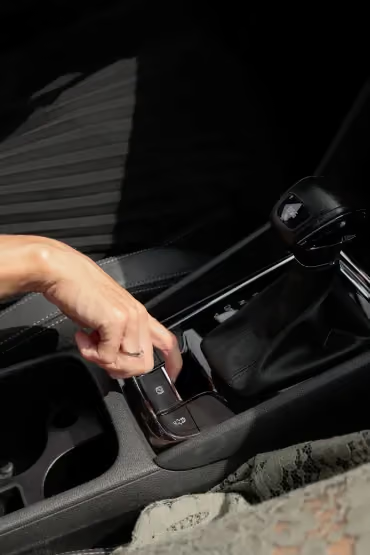
In Estonia, there is a rule that if you perform Driving test of category B with a car with automatic transmission, may continue to drive only with automatic transmissionvehicles. In other words, an indication corresponding to the driver's license is entered (code 78), which limits the right to drive to automata. There is no such restriction when passing the exam with a manual transmission - a driver's license made with a manual transmission allows you to drive cars with both manual and automatic transmission. Ignoring the restriction (that is, driving a car with a manual transmission with automatic permits) is tantamount to driving without the right to drive and is punishable.
It is important to understand that the restriction is due solely to the car for taking the exam. In the course of study, you can try both types of cars if you wish and finally decide which exam to pass - the final choice of the exam car will determine whether or not there will be a gearbox restriction on the driver's license. If, however, the driver's license has been obtained with an automatic restriction (code 78) and later there is a desire to also drive a manual car, the solution is to change the driver's license: you must pass additional trainingat least two driving hours and must be carried out at the Transport Authority additional driving test with a manual carto get an unlimited driver's license. Thus, learning with an automatic box offers an easier path to a driver's license, but later limits the driver's freedom to use different vehicles.
Car with manual transmissionrequires more actions from the driver - the car has three pedals (clutch, brake, gas), and the gear shift is carried out manually with the gear lever. The driver himself, using the clutch, must change gears at the appropriate moment, which requires coordination and practice. Such an additional load makes driving a car more difficult for a beginner, and learning, as a rule, takes more time compared to learning to drive an automatic car. However, driving with a manual transmission makes it better controlsover the vehicle — the driver can more precisely select the appropriate gear and acceleration, which is useful, for example, on slippery roads or in difficult road conditions. Also, when driving a manual, you gain a deeper understanding of the car's operating principles and familiarity with the car, which can improve the driver's reaction and traffic perception. Many car enthusiasts enjoy driving with a manual box as a more active and engaging driving experience.
Car with automatic transmissionIt is much easier for a beginner to manage. The automatic has only two pedals - brake and gas - and the gears are changed by the car itself according to the speed, the driver selects only the driving mode (hereinafter “D”, reverse “R”, etc.). The absence of a clutch pedal means that there is no risk of the engine dying out, and the driver has one less task. Therefore, a novice driver can focus more on traffic and safety, rather than gear shifting. Driving a vehicle is significantly more stress-free with an automatic, especially in urban traffic and traffic jams, where the constant start-stop movement is smoother (the driver does not have to change gears all the time). As noted, there is a car with an automatic box learning to drive easier, which is why it can be a good choice for those who feel insecure about the manual or have difficulty handling the pedals for health reasons. Automatic gearshift also makes the driving experience more comfortable and smooth for the average driver. At the same time, it should be borne in mind that when learning with an automatic machine, the driver may not acquire the “feeling” that occurs when practicing with a manual gearbox - for example, there is no experience in dosing the clutch or choosing a gear by listening to the engine speed.
In summaryThe automatic box option has an advantage in terms of learning: there are fewer learning activities and less technical complexity at the same time. However, learning with a manual box provides more in-depth driving skills and confidence in gaining complete control of the car. The choice depends on the personal preferences and feelings of the driver - some appreciate comfort and simplicity, others want to understand all the nuances of driving from the very beginning.
The choice of the transmission of the training vehicle affects the later choice of vehicleswith which the driver can ride. Driving licence with manual transmissionthe owner has free hands - he can drive both manual and automatic cars, which means a wider choice when buying a personal car, using a car rental or renting a friend's car. This is one of the big advantages of learning with a manual: there is no risk that any suitable vehicle will be left undriven due to the gearbox. For example, many used cars in the lower price range have a manual gearbox, and there are also still plenty of manual models among rental cars (especially in Europe and smaller car groups). Ka Rent a car in a foreign countryon the go, you may find that rental cars with automatic transmissions are more expensive or less available, so the skill of driving with a manual comes in handy. There are also in sharing economy services(such as Bolt Drive, CityBee, etc.) in the selection of many conventional cars, which are often manual. Manual permissions ensure that you can handle these situations without limitation.
Driving license with automatic transmissionOn the other hand, it imposes certain restrictions on the options. Although automatic transmissions are increasingly available — in fact, many newer vehicles (e.g. hybrids, electric cars, and luxury class) only have automatic transmissions — the holder of automatic transmissions can run into trouble if he or she needs to drive a vehicle with a manual transmission. For example, if only manual cars are used in the family or at work, a driver with an automatic limitation will not be able to drive them. This can also prove to be an obstacle in a career: officially, a full (with manual) category B driver's license is often considered an elementary requirement in professions where it is necessary to drive a vehicle. Also, for higher categories (trucks and buses of categories C, D), competence for a manual transmission is required - a category B permit with an automatic may limit the possibility of acquiring these categories. Thus, limiting oneself to an automaton can later reduce the driver Flexibility and possibilities, especially if the choice of cars or work needs require it. Before deciding on automatic permits, it is worth thinking about whether you see yourself needing the ability to drive cars with a manual transmission in the future.
The good news is that today automatic transmissions becoming the normin many car classes. In urban traffic, more and more automatic machines are preferred because of their convenience. If you are sure that your current and future cars will be automatic (for example, plans to acquire a hybrid or electric car without a manual gearbox), learning with an automatic machine may be quite enough. Every manager has their own needs — it is important that the choice falls on the option that suits your lifestyle and plans for the future.
On the technical side, fuel consumption and maintenanceaspects that distinguish automatic and manual transmissions. Traditionally, cars with manual transmission have been a little more fuel efficient— A skilled driver is able to shift gears optimally and use the engine efficiently, achieving lower fuel consumption. In general, there are Manual gearboxes provided better fuel economy, while vending machines have provided convenience. The principle of operation of older automatic transmissions (hydrotransformer slippage, etc.) caused additional losses, which increased the cost. However, in recent years, automatic transmission technology has advanced rapidly — modern automatics shift gears very efficiently and are in many cases able to achieve the same or even better fuel consumption than the average manually-operated manual. Especially for hybrid cars and CVTfor vehicles with variator boxes of the type, the automatic may be even more economical. Thus, the difference in fuel consumption increasingly depends on the model of a particular car and the driving style of the driver, and not just on the type of transmission.
In terms of maintenance and repair, there are manual box generally of simpler constructionand a long-life component. However, there is a cost component in the manual gearbox clutch, which can wear out with intensive use and require replacement. However, replacing the clutch is a fairly standard maintenance operation, and the costs are known. Automatic transmissionis, on the other hand, a more technically complex device - consisting of hydraulic and electronic components - and requires a regular change of transmission oil (ATF) according to the factory instructions. Although transmission failures rarely occur on new cars, automatic transmissions with very high mileage can bring Unexpected additional costsfor repairs. Namely, if a malfunction or wear occurs in the automatic transmission (for example, turbine failure, electronics failure, etc.), repairing it can cost significantly more than repairing a manual transmission. Often, with a breakdown of the automatic machine, it is necessary to carry out a thorough repair or even change the gearbox, which is expensive work. With a manual box, repair costs are typically lower — fewer members to service and better overall durability. A clutch that consumes ruthenium is also considered cheaper and easier to replace than a complete repair of an automatic transmission.
Here it is worth emphasizing that with proper use and maintenance, both types of gearboxes will last a long time. Maintenance costsdiffer in particular when something goes wrong: in a manual it is often possible to limit oneself to changing one part (for example, a clutch), in an automatic one, a failure can mean greater interference. Regular oil changes in the automatic transmission and the correct use of the clutch in the manual transmission will help to avoid high costs. The differences in fuel consumption have narrowed these days — smart automatic control and multi-speed gearboxes ensure good economy. Thus operating costsFrom the point of view, the choice depends in many respects on the driver's preferences: whether one agrees for the convenience of a potentially slightly higher repair costs and a possible slightly higher fuel consumption automatic, or preference is given to the simplicity and slightly more favorable maintenance of the manual.
Automatic vs manual — which one to choose?In short, the decision comes down to the needs and preferences of the manager. Learning with an automatic box offers a more comfortable and easy journeyto obtaining driver's licenses, reducing the stress of a beginner and allowing you to focus on road safety. However, its price is restriction— vending machine permits only allow driving with vending machines, which may limit the range of vehicles and career opportunities in the future. Learning with a manual gearbox is more complex at first and requires more practice, but pays off with a broader set of skills and Flexibility: Manual permits give the freedom to drive all cars and give the driver a complete sense of the vehicle. Economically, the manual also has some advantages (simpler construction, slightly lower costs) although for newer cars the gaps have narrowed.
Pros and cons at a glance:Learning with an automatic box — pluses:easy and quick to learn, less stress, well suited for urban driving; cons:driver's license for limited automatic machines, fewer practice opportunities on a manual, repair of an automatic machine can be more expensive. Learning with a manual box — pluses:full control over all cars, better control and cognition, a wider range of vehicles (including cheaper cars); cons:harder to learn (requires more practice), more labor-intensive in urban traffic (more gear changes), the possibility of clutch-related vipers at the beginning.
The decision should be madeaccording to how you feel: if you really feel that the manual transmission causes excessive difficulties, the automatic is a good solution to become a driver. However, whenever possible, learning with a manual box will give you a wider range of luggage and the confidence that you can handle any car. Ultimately, the goal is to become a safe and confident leader — choose a path that will help you better achieve that goal. And remember: regardless of the gearbox, it is important to focus on safe driving and constant self-improvement as a driver.
Transport Authority: Official information about the theory exam.
Traffic Lab: Teaching materials, exam tests and mock exams.
Estoni.ee: State portal (general information can be found in the driver's license section).
Theory.ee: Another platform for theory learning and test solving.
.avif)