.avif)
Most new drivers want to get their driver's licenses as soon as possible. Although it usually takes several months to acquire the right to drive, with conscious planning and commitment, it is possible to significantly speed up this process. Below we highlight the most important steps and advice on how to accelerate the journey to obtaining the right to drive without sacrificing safety and the quality of learning.
First of all, it's worth figuring out how long it usually takes to get driver's licenses. Basic training in category B includes at least 28 theory lessons and 30 driving lessons, and the duration of the course is a minimum of four weeks according to the law - it is not possible to pass a driving school faster. In reality, the entire path to a driver's license (including graduation from a driving school, state exams and obtaining a driver's license) takes at least a few months. Many people think that learning takes a very long time, which is why they are even afraid to start, but on average it takes about 3-5 months to complete a driving school, depending on the capabilities and pace of the learner (for more details, read in the article How long does it take to go through driving school?).
It is important to take into account that obtaining a driver's license involves several stages: a theory course and a school exam at a driving school, passing driving lessons, mandatory additional training (for example, first aid, blind driving) and state theory and driving exams at the Transport Authority. Each stage adds time - for example, waiting times for exams can be several weeks or even months in more popular cities. Therefore, it is important to plan the entire process as a whole in order to avoid unnecessary delays at each stage.
The fastest way to driver's licenses is provided by a correctly selected driving school and form of study. Find out if any driving school offers a category B speed course - intensive training for those who want to acquire a driver's license especially quickly. For example, there are driving schools where the standard period of study in an express course is about 1 month (when passing the necessary lessons), and teaching is organized on a tight schedule. Often, speed courses allow you to complete the theory course in a shorter time and start driving lessons earlier, which shortens the total duration.
It is also worth giving preference to a driving school with a flexible schedule and the possibility of e-learning. With e-learning, you can complete the theory at a time and pace that suits you — for example, in Sky Driving School e-learning you can study anywhere and choose the times and pace that suit you. This means that you can study more intensively if necessary (for example, every day) and not be dependent on the schedule of the classical study group. The flexible form of study allows you to master the material as quickly as you want, which is the basis of fast learning.
When choosing a driving school, also find out how wide a schedule the driving instructors work — if the instructors operate every day from morning to evening, it is easier to find the hours of driving lessons closely according to your time. Some driving schools allow you to book driving lessons even on weekends or outside of normal business hours. The more flexible and intensive the training organization, the faster you will get all the necessary lessons done.
(Tip: For more information on driving school costs and courses, see the article “What are the hidden costs of driving school?”, which explains what the course price includes and what additional costs may still be incurred.)
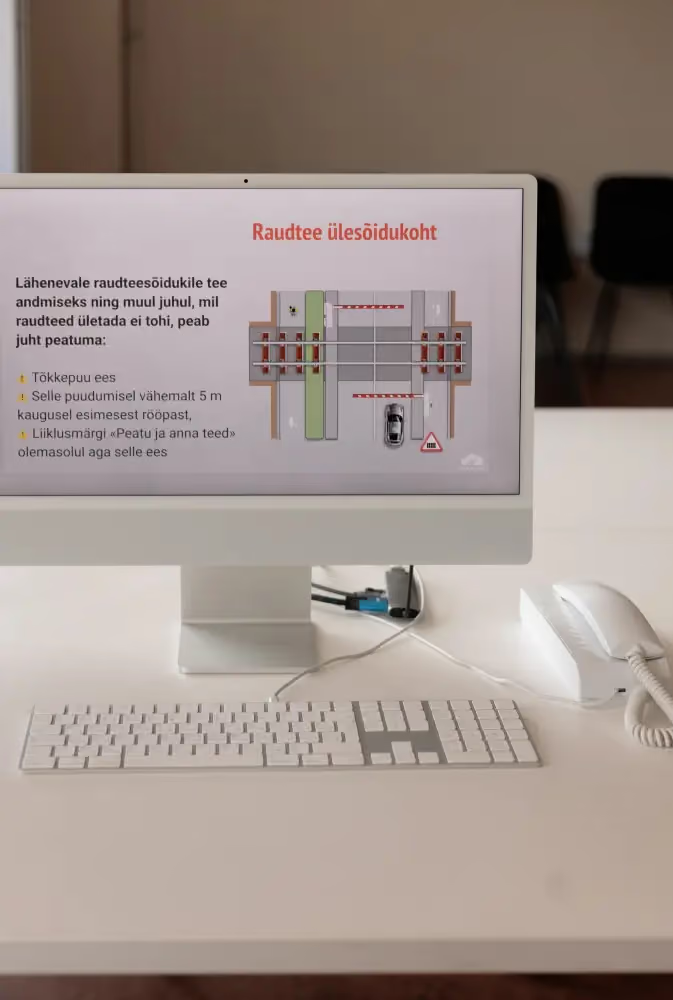
One of the biggest mistakes students make is to leave driving lessons until after they finish theory. In fact, practical driving training should be started as early as possible, ideally in parallel with theory studies. The sooner you start driving lessons, the faster you will get to the end with the whole learning process. If you postpone your rides, getting your driver's licenses can be a stretch, because acquiring driving skills requires consistent practice and a commitment of time.
According to experienced instructors at Sky Driving School, students who start driving in parallel with the theory acquire skills faster, because they can immediately apply what they have learned in practice and hone their technique. Keeping theory and practice hand in hand makes learning more intense and consistent, leading to faster exam readiness. In addition, the freshness of theoretical knowledge remains - if you learn the rules and can immediately try them in traffic, what you have learned will be more effectively consolidated.
A flexible schedule is a big advantage here: many driving schools (for example, Skydriving School) allow you to start driving lessons already at the initial stage of the theory course. This means that no need to waitthe end of the theory lessons before you start practicing the steering wheel. Plan several driving hours into your week — ideally at least 2 to 3 driving hours per week — to keep the momentum up and go faster in the required amount of driving. Regular rides help prevent a decline in skills due to long pauses, and Consistency creates habitsthat make you a more confident leader.
To speed up learning and gain more confidence in the steering wheel, if possible, also use additional practice with a competent instructor outside of official driving lessons. Estonian law allows driving school students to practice driving under the guidance of a private teacher (supervisor) — for this purpose, the person who is the instructor must be a driver with at least 5 years of experience and apply for a supervisor certificate from the Transport Authority. The tutor can be, for example, a family member or acquaintance who meets the requirements.
Riding with an instructor gives you the opportunity to gather more practice and do it flexibly at your own pace. Many young drivers who have successfully passed the exam have honed their skills with the help of extra drives - for example, one student mentioned that he drove in two months, in addition to driving school lessons, practicing with an acquaintance, and achieved driver's licenses in record time thanks to his full dedication. If you have the opportunity to practice with an instructor, make the most of this time.
Remember that when practicing with an instructor, all requirements must be observed: the training vehicle must have the “Learning Ride” badges, must be accompanied by a driving school study card indicating that you are allowed on the road independently, and a valid instructor certificate from the instructor. With the right guidance, private driving can be a great addition to formal classes, helping you to become proficient faster.
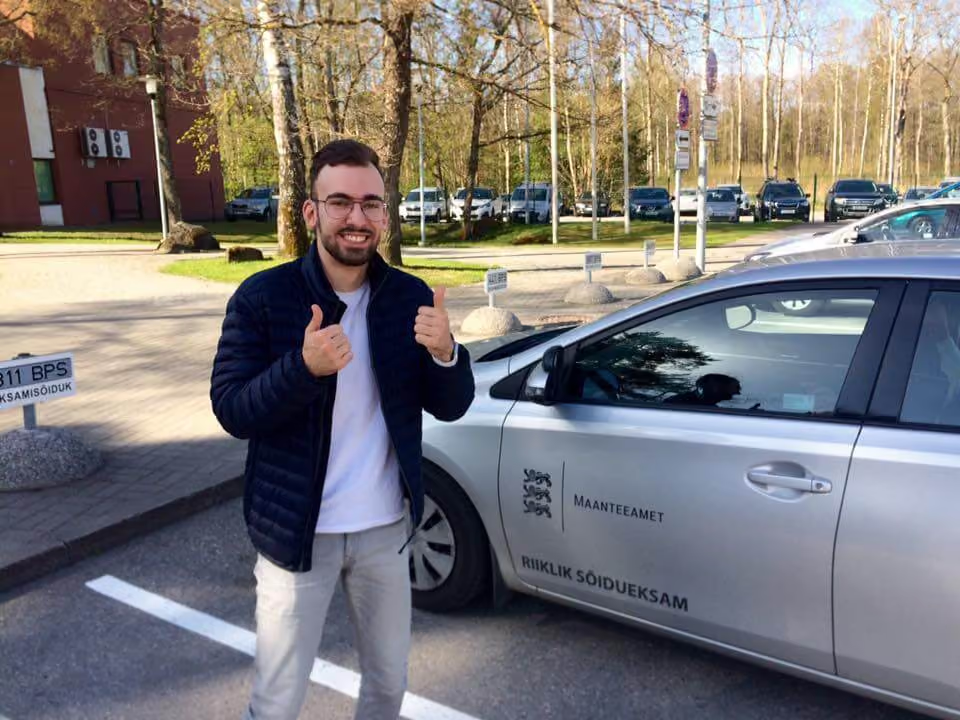
Waiting times for state exams (theory and driving exam at the Transport Authority) are often just the place where the whole process slows down. Register for exams as soon as possible — as soon as you have completed the relevant stage of the driving school (theory or driving) and have completed the required items. The theory exam can be taken even before the end of driving lessons (it is necessary to pass the driving school theory exam and the minimum age is 15.5 years for category B), but you can register for the driving test after receiving the driving school diploma. Do not delay the exam time even if you still feel insecure - it makes sense to book an appointment in advance, because it can be canceled or postponed later if necessary, but delaying it may simply not be possible to find a suitable time.
Depending on the city and the season, the queue for the driving exam can reach several months, so it is recommended to book an appointment as soon as possible. The Department of Transport allows exams to be passed in any service officeall over Estonia, regardless of the location of the driving school. Use it to your advantage: if there are long queues in your hometown, look at times in other cities. For example, students have shared the experience that they should have waited a long time while waiting in Tallinn, but Haapsalu managed to get the driving test time significantly earlier - and the exam itself was also easier to pass due to the calmer traffic. However, it should be borne in mind that it is wise to take the exam in the area where you will be driving in the future; a foreign city may be easier, but it is also important to gain real traffic experience in a familiar environment.
Be active in playing with exam time: The Transport Office e-service occasionally releases canceled exam times that have been canceled by others. We advise you to check the booking system daily to catch any available times. Many students have been able to get an exam earlier thanks to keeping track of the constantly opening times — sometimes you can even get a suitable time for the next day if someone cancels their reservation. So be consistent and make sure you have your exam time listed as early as possible.
Getting a quick driver's license doesn't just mean rushing — it's just as important to be well prepared for your exams. Any failed test inevitably entails a delay (e.g. retaking a category B driving test is only allowed 30 days after a failed test) and additional costs. Thus, passing the exam for the first time is one of the key factors for saving time. The Transport Authority now prefers new graduates when assigning exam times precisely because they immediately go to the exam with fresh skills - this increases the likelihood of passing the first time.
When you are about to graduate from driving school, discuss honestly with your driving instructor whether you are ready for the exam. If necessary, invest a few extra driving hours before the exam to polish the weak spots - this is a faster path to driver's licenses than failure and a months-long waiting time for a reexam. Also use modern aids: practice plenty of theory tests (for example, in the environment of the Traffic Lab) and pass trial exams both in theory and driving. Many driving schools offer the opportunity to test driving testwith your own instructor, which simulates the state exam and helps to tame nerves and point out mistakes in advance.
Before the driving test, be sure to familiarize yourself with the test vehicle (if it is different from your study car). If you wish, you can ask for a few minutes on the field to feel the car - for example, practice the feeling of the clutch, the input of gears, the sensitivity of the pedals. Small details, such as the operation of the reversing camera or the switching of the chambermaids, are worth reviewing before. If you feel comfortable in the car and have practiced enough city driving, you will fewer surprises on the exam.
Keep the knowledge you have learned fresh: even if the theory exam was taken months before the driving test, repeat the most important rules and road signs. Mistakes made in theory often manifest themselves while driving. Be sure to go to the exam in a rested and focused state - rushing to study at the last minute can do you a disservice. Rather, learn consistently throughout the course. Good time planning and sufficient practice are the best combination to ensure a quick and successful driver's license.
When applying for the right to drive, in addition to basic training at a driving school, there are a number of mandatory additional courses and documents, without which a driver's license cannot be obtained. Going through them early helps to avoid later delays. Already during or immediately after driving school, be sure to do the following:
Meeting all of these requirements early ensures that once the driving test is done, permits will no longer get stuck behind red tape or a missing piece of paper. Many people who rush through driving schools have lost valuable time simply because they discovered at the last moment - a first aid certificate is missing or a medical certificate is missing. Do not let this happen and do all additional training and actions on time.
When issuing driver's licenses quickly, it is also important to think through the financial side. Intensive training and a tighter schedule may mean you have to cover more expenses in a shorter period of time — but at the same time, a faster graduation can be more advantageous if you avoid the need for reexams and extra hours. Here are some costs worth considering:
Going to a fast driving school does not necessarily mean more expense than studying for a long time - on the contrary, stretching can increase costs instead (more hours, more exam attempts). Plan your budget comprehensively: calculate all expenses from tuition to state fees and equipment (for example, the fee for a first aid course) and leave some margin for the unexpected. You can also read more about the cost of driving school in our article What are the hidden costs of driving school?to avoid surprises in financial terms.
Quick acquisition of driver's licenses is achievable if you are willing to invest intensively time and attention and do the preliminary work wisely. Choose the right driving school and form of study, start driving lessons early and keep up the pace as you study. At the same time, do not forget about quality - in the end, it is important that you become a competent and safe driver. By planning exams early and preparing for them thoroughly, you increase your chances of success on the first attempt. Complete all required training and formalities on time so that they do not hinder your journey.
If you follow these tips, you can get your driver's license significantly faster than the average graduate, while keeping your nerves in order and your wallet in check. Speed does not mean haste, but smart action - this is how you reach your goal quickly and safely. Good study and success in exams!
Transport Authority: Official information about the theory exam.
Traffic Lab: Teaching materials, exam tests and mock exams.
Estonia.ee: State portal (general information can be found in the driver's license section).
Theory.ee: Another platform for theory learning and test solving.
.avif)